The goal is to grow old.
Aging is the single biggest cancer risk factor. Not genetics. Not lifestyle. Age. We are building a new standard of care for every patient who has run out of options.
Age is the enemy.
Not the genes.
By 2030, the world will see 0.6 million new cancer cases per year. The most powerful driver is not what we inherit or how we live. It is simply getting older.
Radiation therapy has improved dramatically over two decades. Yet for some cancers, the ones that return, the ones that cannot be cut out, the ones already treated twice, there is still no good answer.
Illustrative. Based on global incidence data. Source: Lancet Oncology, 2015.
Radiation therapy has saved millions.
For some cancers, it is not enough.
The ones that return. The ones that cannot be cut out. The ones already treated twice. For these patients, conventional methods run out of answers.
The cells
Normal cells. Cancer cells. Side by side.
BNCT requires two components. Neither works alone.
The cells
Normal cells. Cancer cells. Side by side.
BNCT requires two components. Neither works alone.
The fundamental difference
Conventional radiation targets a volume. BNCT targets a cell.
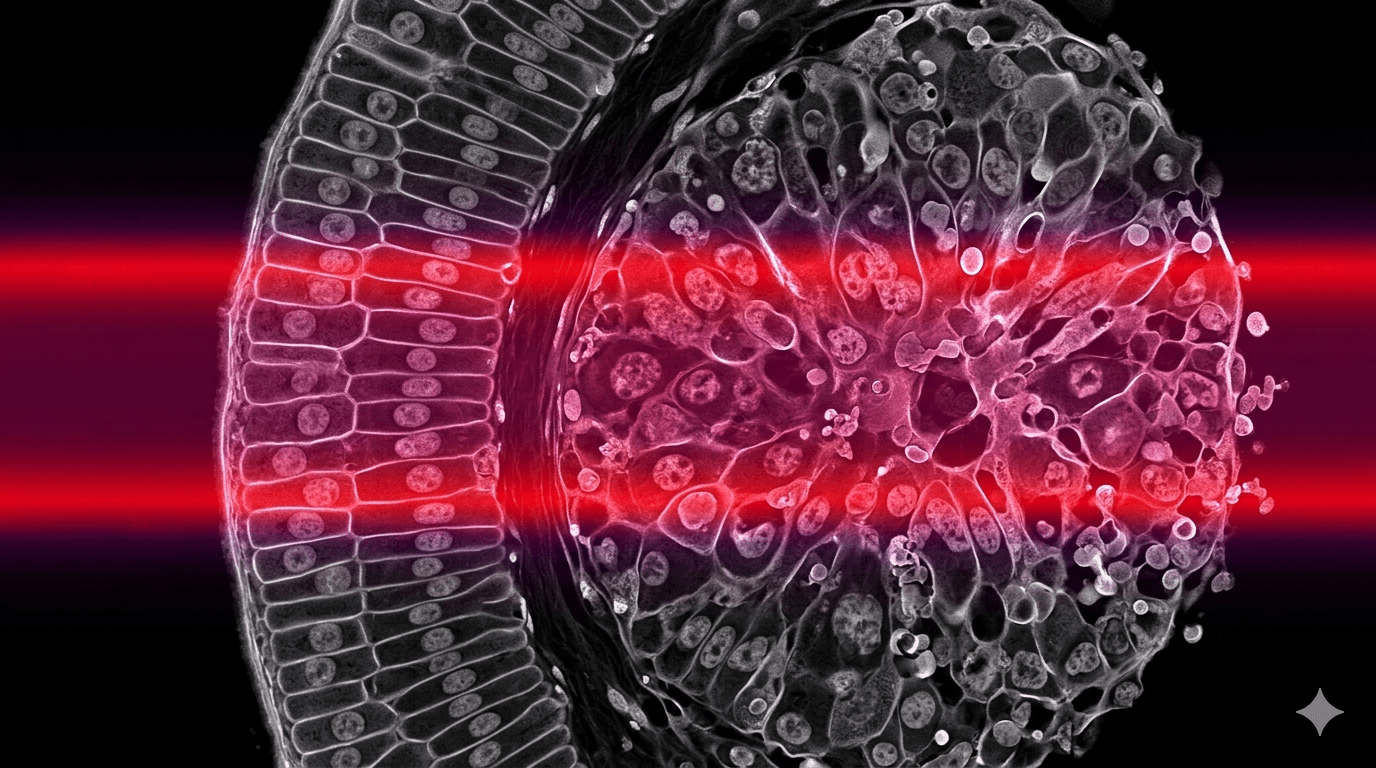
A broad radiation zone hits both healthy and cancerous tissue. The beam cannot distinguish between them.
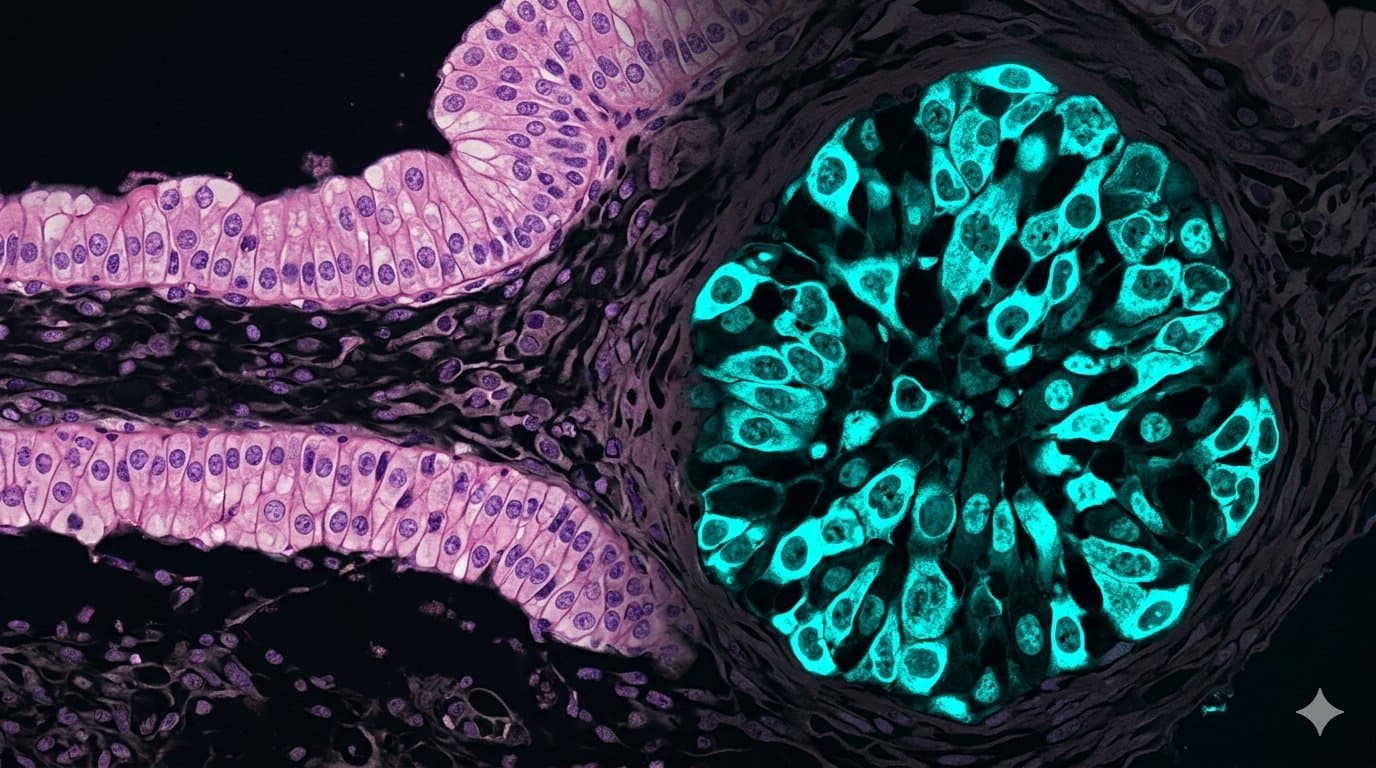
The nuclear reaction between boron and neutrons occurs only in boron loaded tumor cells. Normal cells are spared.
Target: cell vs volume
Conventional radiation optimizes dose to a volume of tissue. BNCT reacts only inside cells that have absorbed boron. The precision is fundamental, not incremental.
Normal cells: collateral vs spared
Any normal tissue in the treatment volume receives dose conventionally. With BNCT, normal cells without boron are effectively transparent to the reaction.
Sessions: 40 vs 1
A conventional radiation course runs up to 40 daily sessions. BNCT is typically a single session. Patients travel in, are treated, and go home.
“The target is defined by biology. Not by humans.”Prof. Dr. med. Wolfgang Sauerwein
Illustrative representation. Images do not depict actual clinical data.
One treatment.
One day.
One more chance.
For patients with recurrent head and neck cancer where no options remained, clinical studies documented complete responses. BNCT doesn’t just treat differently. It asks less of the patient.Kankaanranta et al., IJROBP, 2012.
During treatment
Conventional radiation
Up to 40 daily sessions over 4 to 8 weeks. Recovery time, fatigue, and hospital stays are common.
BNCT
One session. No weeks-long treatment phases.
If not now, when?
One center. An entire region served.
Patients travel for a single day. Be the region that made this possible.
A new standard of care is being built.
A standardized, scalable blueprint. Strong unit economics. 1 million addressable patients per year.
Help define the global standard.
Prof. Sauerwein is building the European clinical protocol. Join the network.
The numbers speak for themselves.
In recurrent head and neck cancers with no remaining treatment options.
Kankaanranta et al., IJROBP, 2012
Against 14% after stereotactic radiotherapy.
Koivunoro et al., Radiother Oncol. 137, 2019
One session. No weeks-long treatment phases.
Clinical protocol standard
Data based on published peer-reviewed clinical studies. BNCT is approved for clinical use in Japan (2020). Regulatory status varies by country.
The science was always right.
Now the technology is ready.
For 80 years, the physics was understood but the infrastructure was not. Compact accelerator-based neutron sources have changed that.
Locher proposes boron neutron capture for cancer.
Early clinical attempts in the US.
Successful treatments in Japan by Prof. Hiroshi Hatanaka.
Systematic clinical development in Europe and the US.
Compact hospital-based neutron sources become viable.
Japan grants first regulatory approval for BNCT.
Standardised blueprint. Coming to the world.
- xNuclear reactors only. No hospitals.
- xNo systematic drug development.
- xNo regulatory framework.
- xAvailable only to a few patients.
- +Compact accelerators fit inside a hospital.
- +Drug development by pharmaceutical industry.
- +Approved in Japan for head and neck cancer. Clinical trials underway in Asia and Europe.
- +Standardised blueprint for global rollout.

“We urgently need well-designed clinical trials. The window is open. The technology is ready. Now we act.”Prof. Dr. med. Wolfgang Sauerwein
Prof. Dr. med.
Wolfgang Sauerwein
- Professor of Radiation Oncology, University Hospital Essen (retired)
- Highly decorated by the Japanese government.
- Pioneer of clinical BNCT in Europe
- 40+ years in radiation oncology research
- Editor of Neutron Capture Therapy: Principles and Applications (Springer)
Community
Advancing BNCT together.
Sponsor of the DGBNCT
The Deutsche Gesellschaft für Bor-Neutroneneinfangtherapie e.V. (DGBNCT) is the German scientific society dedicated to advancing the clinical application of BNCT. Founded in Essen, its goals include establishing a German BNCT centre as an interdisciplinary university facility and fostering the next generation of researchers.
BNCT Global is a sponsor of the DGBNCT and supports its mission to bring BNCT into clinical practice in Germany.
Visit dgbnct.comIs BNCT the Future of Radiation Oncology?
Next congress: date to be announced · Würzburg
FAQ